

The Pine Family
by Ithell Colquhoun

How to find a way into a painting of three pieces of wood that look like mutilated bodies? It was a challenge, for sure. So I decided this time to tell a story with hints of abuse and revenge and I’m leaving it to your imagination, dear Reader, to fill in the gaps.
Colqhoun’s artworks are by turns disturbing, enchanting and suggestive and I urge you to seek them out. There’s no need, I think, to subscribe to her complex, occult beliefs in order to enjoy the pictures although if you a practitioner of sex magic as she apparently was, you’ll feel right at home!
You can find details of the possible references to myth, slang and psychoanalysis in The Pine Family here.
My rather grim tale is of course only one way to interpret this extraordinary painting and I have a feeling that there is a joke about hypermasculinity, or of classification by genital anatomy, in Colquhoun’s picture.
Let me know what you think!
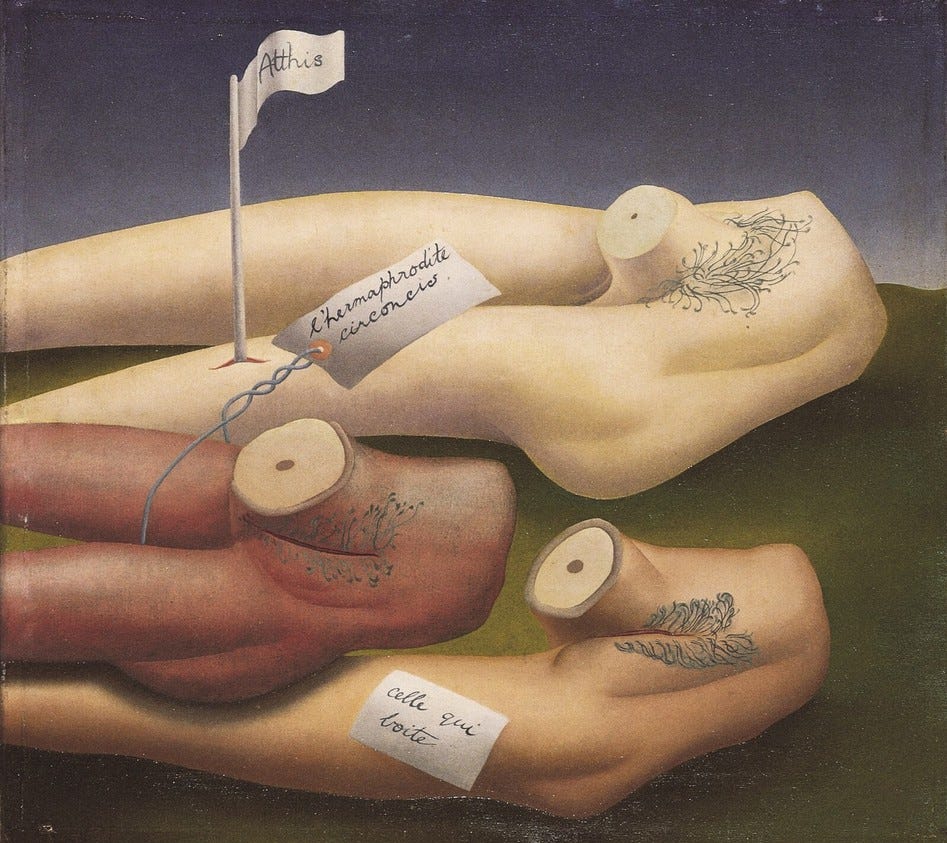
It was many years since Emily Pine had seen her family. Self-sufficient in vegetables and hens’ eggs, with a pig for meat and sheep for wool, she wove blankets and traded them for flour and sugar. It was a hard, solitary life and it suited her.
At dusk, under cover of half-light, she felled branches in the forest to warm her house and cook her meals, using an axe and saw inherited from her father. She wielded the tools with an anger derived from the memory of the violence and abuse of her childhood.
She had run from that at 14, dressed as a boy.
Now, over 50, she lived so far from doctors that a slight limp had developed into a halting gait.
It was November, and time to light the fire in the afternoons again. She went to the woodshed, fragrant with sap and mouse droppings, and filled the log basket with short sections of bifurcated branches for her fire.
Once indoors, she knelt by the range and fell into a daydream as she examined each log, setting aside three of them.
The first was forked like two legs, and there was a stump where the legs met, and where she had chopped off another part. This she named Atthis for the castrated god, and found a skewer to pierce into the thigh, attaching a label to it. The sound of the skewer splintering the wood gave her a revengeful satisfaction.
The second forked log she named the Hermaphrodite and looked at it longingly.
The last was one-legged and reminded her of her own limping stride.
Each of these wooden icons she decorated with flourishes of inked-on pubic hair. That night, as they burned in her fireplace, she relived her childhood violation, her adolescent escape and the dawn of her disability, and made her peace with it all.